GNSS Academy supports companies with GNSS/PNT engineering consulting, helping teams de-risk decisions, accelerate development, and validate performance across a wide range of navigation projects.
Complete the form with your information and needs, and our team will contact you as soon as possible
We support bids and technical proposals by shaping the solution approach, defining scope and assumptions, and clarifying performance targets
We run feasibility and trade-off studies to de-risk key choices early, turning uncertainty into clear recommendations and a roadmap for execution.
We build and run simulators and analysis tools to predict system behavior, quantify performance with synthetic data, and assess performance sensitivities.
We build testbeds and test them on representative data to validate approaches, and prove value-fast iterations that accelerate learning and reduce time-to-solution.
We assess and optimize navigation performance either accuracy, availability, continuity, integrity, robustness, and resilience, at system or user levels by defining the right KPIs, running analyses on real or simulated data
We design GNSS/PNT algorithms at system or user positioning levels based on estimation filters well tuned to meet the expected level of performance requirements
We implement code and tooling in different languages Python, C/C++ with a clean architecture, version control, and reproducible workflows, so solutions are maintainable, testable, and ready for integration.
We define validation approacheds, metrics, and datasets, then execute verification and validation to demonstrate performance and compliance, building confidence for reviews, qualification, and acceptance.
We help define the DEVOPS Operational requirements and monitor performance in real time conditions, investigate anomalies, and refine the configuration parameters for the working states and condtions
We deliver project-focus training for end customers and operational users, designed to ensure they can run, monitor, and fully understand the delivered product or service with trouble-shooting capacity to solve for anomalies or non-conformities
WE SUPPORT AT
WE MASTER
SOME FIELDS OF EXPERTISE
SPACE
GROUND
ORBITS
CLOCKS
IONOSPHERE
SIGNALS
HYBRIDATION
ALGORITHMS
INTEGRITY
AUTHENTIC.
IN-HOUSE PROJECTS
For SBAS (Satellite-Based Augmentation Systems), we have developed a suite of engineering tools to validate and benchmark the performance of EGNOS V2 and EGNOS V3 across the full chain—satellite/SIS, ionospheric modelling and corrections, range domain, and user domain. Our tooling supports both service-volume level assessments (wide-area performance mapping) and receiver-data driven analyses using real measurements. To close the loop from corrections to user impact, we also built an in-house positioning engine that computes SBAS-based solutions and enables detailed evaluation of accuracy, integrity, availability, and continuity under representative operational conditions.
For PPP (Precise Point Positioning), we have developed a set of in-house tools and algorithms focused on high-accuracy, global positioning. Our work includes the implementation of a Kalman Filter–based PPP engine with ambiguity resolution, designed to deliver precise and stable solutions under realistic conditions. The processing chain is fed with precise orbit/clock and bias products from multiple sources—including modern services such as the Galileo High Accuracy Service (HAS)—allowing us to assess end-to-end performance and support the development and validation of next-generation precise positioning capabilities for demanding applications.
For GNSS/IMU Sensor Fusion, we have developed algorithms and simulation tooling to evaluate integrated navigation performance using synthetic GNSS and inertial measurements across a wide range of scenarios. We simulate measurements in different environments (open-sky, degraded, challenged) and under varied vehicle dynamics, then test multiple integration architectures loose coupling, tight coupling, to run sensitivity analyses and quantify how factors such as dynamics, IMU grade, GNSS errors/outages, and measurement quality impact accuracy, robustness, and continuity.
For LEO PNT (Low Earth Orbit Positioning, Navigation and Timing), we have developed a dedicated Service Volume assessment framework to study future navigation constellations in low Earth orbit. This toolset allows us to model candidate LEO-PNT architectures and quantify coverage and performance across the service region—analyzing geometry, visibility, and key service indicators to understand how next-generation LEO constellations could complement or enhance traditional MEO GNSS for more resilient and higher-performance PNT.
For Precise Orbit Determination (POD) in LEO, we have developed processing capabilities and tooling to perform POD using on-board GNSS receiver data from missions such as Sentinel-1 and Sentinel-6, leveraging measurements from GPS and Galileo. Our framework ingests real flight receiver observations and applies orbit determination and quality assessment workflows to estimate and validate precise satellite trajectories—supporting mission needs such as navigation performance monitoring, product quality evaluation, and sensitivity analyses across measurement conditions and modelling assumptions.
For Ionosphere Analysis, we have developed a complete toolkit covering both characterization and estimation, enabling detailed studies from raw measurements to service-level performance. On the characterization side, we compute key ionospheric activity indicators such as ROT and AATR, supporting anomaly detection and scenario classification. For estimation, we implement algorithms to derive TEC, and we perform performance analyses using standard products such as IONEX. In addition, we assess SBAS ionosphere by processing ionospheric grid information (e.g., GIVDs from MT26 messages) disseminated by systems such as EGNOS and WAAS, allowing us to evaluate the impact on user-domain performance.
For GNSS Signal Processing and Receiver Protection, we have developed signal acquisition and tracking algorithms using real GPS and Galileo signals, complemented by advanced scenario generation with tools such as Skydel to simulate signals under a wide range of conditions. This includes controlled environments with different dynamics as well as interference and threat scenarios—jamming and spoofing—to evaluate receiver behavior and design protection and detection capabilities at receiver level.
For Threat & Fault Injection in safety-critical navigation, we have developed simulation and data-generation tools that inject feared events into GNSS/PNT scenarios—such as clock jumps, message anomalies, and other system or measurement faults. This controlled fault injection capability is used to design, tune, and validate integrity barriers that must detect and mitigate failures before they can impact users. It is particularly suited to supporting SBAS integrity chains (e.g., EGNOS V3), where robust monitoring, fault detection, and protection logic are essential to maintain safety performance under off-nominal conditions.
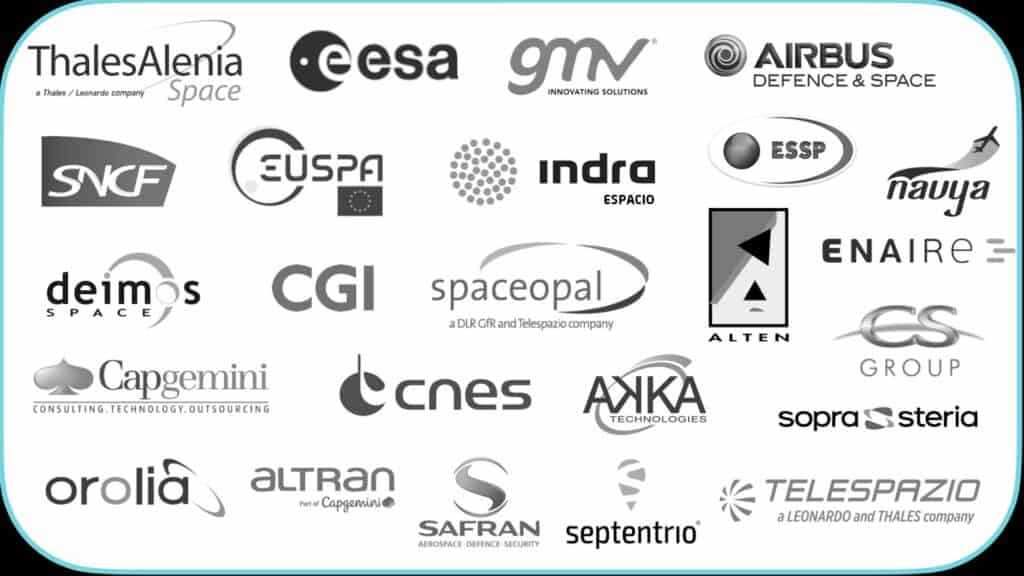
We COLLABORATE WITH THE MAIN EUROPEAN PLAYERS
Complete the form with your information and needs, and our team will contact you as soon as possible